
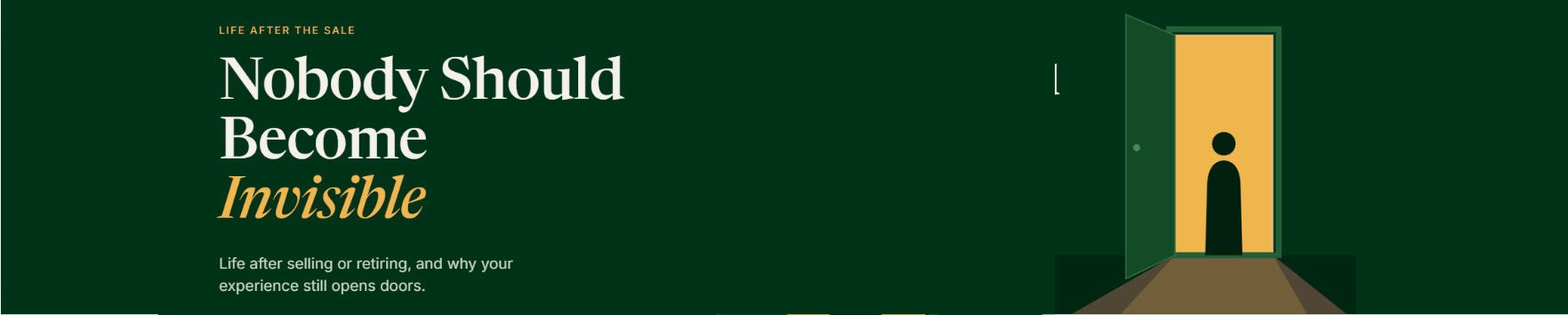
Nobody Should Become Invisible
Life after selling or retiring, and why your experience still opens doors.
In my last article, It Only Takes One Yes, I wrote about the cup of coffee with my mentor that helped me sell GroForth. This one is about what comes after.
The quiet after the sale
When people sell or retire from a business without preparing for it, many tell me they feel invisible. One person described it as being banished from the business community. Strong words, but that is how it felt to them. Another said they did not expect to feel so invisible after they retired from their position.
I was better prepared than most. I had watched family members sell their business and knew what could follow. I knew I'd no longer be of much use to many of my contacts, and sure enough, a lot of those conversations stopped. Not even a greeting or a wave when we met at a networking event, that was the reality.
I chose to accept that, but I didn’t let it define me, I had someone who showed me another way. Mícheál is proof it doesn't have to be that way. My mentor had built and sold a business of his own, yet he has never been invisible. More than ten years after we met, we still sit down for coffee and talk about business, and always about the human side of it.
He still opens doors for people. He still gets excited about young peoples’ futures. And he taught me that I'm not invisible either.
Now this is a question you need to ask yourself on a regular basis in your professional and personal life and you’ll have heard me ask it before - What do you actually want?
Redefining Retirement
Retirement comes up around me constantly, in conversations with people aged 50 and older and in business meetings. I think the word needs redefining. Retirement, or life after a sale, should be what you want it to be, not what you assume it's supposed to be.
When I coach business owners preparing for a sale or retirement, they usually start with a very standard version of what’s next, with what usually happens. My next question is always the same: is that what you want? In an ideal world, no holds barred, what does life after the sale look like for you?
There's usually a pause. A quietness. Then the conversation opens up, they tell me what they'll miss, what they'd change, and a new plan begins to form.
Many who retire go back into pro bono work, mentoring, or a smaller business they're genuinely interested in. Many who sell want some time out first. Some then find a partner and start again on their own terms: four days a week, seasonal, or simply ‘let's try this and see.’
I've lived a version of this myself. My mentors question, "Why are you really selling?", is one I now ask others. The honest answer is where every good plan starts.
Experience is never irrelevant
As we grow older, we gather a wealth of knowledge and experience. The businesses coming up behind us may look nothing like ours and some didn't even exist in our time. That knowledge still matters, because so much of business is about communication, how we treat ourselves and how we treat others.
New technology doesn't make experience less relevant. The people older, wiser and more knowledgeable than us should never be invisible. They are the ones who open doors, guide us, encourage us and believe in us.
Recently I gave some advice to a young man who had passed his accountancy exams and was starting his tax exams. He smiled and said, "You're not the first person to tell me that." When everyone gives you the same advice, it's worth pausing to ask why. Usually it's because they want you to succeed.
Opening doors for others
Opening a door is often simpler than people think. Even while I was running GroForth, I tried to do for others what my mentor did for me, usually through an introduction.
I had the opportunity to introduce people to other industries and professions, to help them find out if a particular career was really for them. I connected founders with investors, and investors with founders. And for others, I could often put someone in touch with a contact who could advise them in an area outside my own skill set.
None of these took much time or effort for me, but for the other person, that one introduction could be the yes that changes their direction.
Be someone's yes
You have a choice after you sell or retire. If you've spent your whole life in a business community, do you still want to be part of it? If so, what's stopping you? Why not help others?
I've been lucky. Many people have opened doors for me, and I worked hard because I didn't want to let them down. Those who went before me, shared what they had learned whenever I asked. Now it's my turn, and maybe yours.
It only takes one person, and one yes.
Who could you say yes to this week?
_________________________________________
References
O’Loughlin, K. (2025) Eddie Jordan: full throttle: lessons from a life of motorsport, money and mischief. London: Quercus.
Whyman, M. (2024) Inside Mercedes F1: life in the fast lane of Formula One. London: Century.
Wolff, S. (2025) Driven. London: Hodder & Stoughton.
W A Y S W E C A N W O R K T O G E T H E R
The support that's right for you.
Three programmes, designed for where you are right now.

The Clarity Intensive
Decision Readiness Session
For owners and directors who know something needs to change but aren't yet sure what. Through a blend of coaching and commercial thinking, we explore every option through two lenses: what's right for you as a person, and what's right for the business.
Runs at your pace · Typically 6 sessions

The Transition Programme
Transition Advisory
For owners who have made their decision and are ready to move. Whether you're selling, merging or retiring, this programme supports the full transition, preparing the business while helping you navigate the personal side of stepping away.
Runs at your pace · Typically 6–18 months
The Leadership Programme
Building You As A Leader
For executives and directors who want to change how they lead. Helping you figure out what it takes to commit, what gets in the way, and how to build something that actually holds.
Typically 6–12 month commitment
