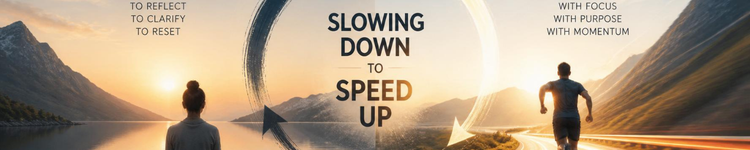
Slowing Down to Speed Up
-
Part 1: Why the Best Business Decisions Happen When You Stop Moving
‘Without reflection, we drift.’
In a world of constant disruption, the anxious question every leader carries is some version of this: ‘If I don't do fill-in-the-blank-thing right now, could someone else beat us to it, and box me out for the next 20 years?’
It's a real fear, and a reasonable one.
The leaders who make the best decisions are the ones who've learned that pausing, done well, isn't the opposite of speed, it's what makes speed useful. I would argue that pausing and giving time for reflection is not a luxury but
a leadership discipline, and in this series, I want to show leaders how to build it in.
Making Reflection a Discipline
We need to adopt the habit of pausing to think and reflect.
It’s my strong belief, backed by research, that business owners, directors and leaders are not putting adequate time aside for this vital habit, and to the detriment of themselves and their businesses.
What I see time and time again is leaders adopting this habit too close to burnout, or during their burnout recovery. While it’s never too late, sooner will always be better, and building this strategic habit into your calendar now could change the trajectory of your career and business.
The Power of the Active Pause
Done is better than perfect but doing is not always better. The fear of being ‘boxed out’ drives leaders to keep moving without ever checking whether the direction is right. But sometimes the fastest path forward is a deliberate, ‘active pause’. This is not indecision, but a conscious choice to gather better information before committing.
Cutting Through the Noise
Information overload within organisations and in society generally can be a big distraction and you as an individual need to become more selective about what information you and your organisation work with. To be able to achieve this, the clearest recommendation is to pause to read, reflect, reorganise, think, exercise etc.
What Happens When We Embrace the Pause
Constant motion isn't the same as progress; sometimes it's the opposite.
What happens when we embrace the pause.
In a 2017 article, linked below, the writer shared that leaders in this complex world need to ‘recultivate the art of reflection’. Despite the fact that the article was written almost a decade ago, it is still relevant, possibly even more so, given how much information overload has intensified since.
The Reading Habit of Great Leaders
Warren Buffett has said that he reads 6 hours per day and has very few meetings - an increasingly rare habit it seems. During a recent conversation with an international training consultant, I brought up the surprising lack of reading amongst not just certain levels of management but all levels of management internationally. She agreed and explained that when we give presentations to clients where we refer to books, we need to include sentences instead of bullet points on slides. The reason for this is that the audience are likely to photograph the screen or write down the sentence being referred to but are very unlikely to actually read the book that’s being mentioned. However, when we think about the ‘extraordinary vs mediocre’ it’s worth noting that Warren Buffet isn’t alone in his reading habits, there are a number of other CEOs, such Bill Gates and Mark Zuckerberg, who have the same extensive reading discipline. If you’re ready to start reading more today, I’ve included at the end of this article, the various Harvard Business Review articles I’ve drawn from to write it.
The Discipline of Self-Reflection
A more recent article titled ‘Don’t Underestimate the Power of Self-Reflection’ explores how ‘the habit of reflection can separate extraordinary professionals from mediocre ones’ - a powerful statement. The article discusses a study of 442 executives asking them which experiences had the biggest impact in their development as leaders. Three themes emerged through their analysis: surprise, frustration, and failure.
To learn how those themes showed up and how reflection can impact each one, keep reading.
We're constantly predicting what happens next based on what's already occurred, so when reality doesn't match our expectations, we're caught off guard. That gap between what we expected and what actually happened is exactly where reflection does its best work.
Frustration surfaces when our goals are blocked - by delays, criticism, or systems that don't work the way they should. Because our goals are rooted in what we value,
frustration is really a signal worth paying attention to, and pushing through it builds sharper communication, problem-solving, and patience.
Failure is often less about the mistake itself and more about what we do with it afterwards - it teaches by negative example, showing us exactly what not to repeat. But that lesson only lands if we stop long enough to actually reflect on it, rather than rushing straight past the discomfort. None of these three produce growth on their own. Surprise, failure, and frustration only become development opportunities when we pause to reflect on them, rather than rushing straight past the discomfort.
At the end of the article, they remind us that our mind is like a muscle, ‘it needs reflection to recover and grow stronger’.
Why Organisations Don't Learn
Another article titled ‘Why Organizations Don’t Learn’ reenforces the importance of blocking out 30 minutes a day to just think. In one study at an Indian call centre, workers who spent fifteen minutes reflecting on what they'd learned each day outperformed a control group by more than 20% on a later test. Blocking out just 20 to 30 minutes a day simply to think - whether planning the morning ahead or reviewing how the day went, and protecting that time, could be worth a try, right?
Building This Into Your Own Life
To learn how to build these strategies into your own life, read next months article.
And when you need a coach or change facilitator skilled in practicing the pause, you can get in touch with me
here .
_________________________________________
References
Articles and books mentioned:
Badaracco, J.L. (2020) Step back: how to bring the art of reflection into your busy life. Boston, MA: Harvard Business Review Press.
Tuff, G., Goldbach, S. and Johnson, J. (2024) 'When an active pause is the best strategic choice', Harvard Business Review, 15 January. https://hbr.org/2024/01/when-an-active-pause-is-the-best-strategic-choice
Reeves, M., Torres, R. and Hassan, F. (2017) 'How to regain the lost art of reflection', Harvard Business Review, 25 September. Available at: https://hbr.org/2017/09/how-to-regain-the-lost-art-of-reflection
Bailey, J.R. and Rehman, S. (2022) 'Don't underestimate the power of self-reflection', Harvard Business Review, 4 March. Available at: https://hbr.org/2022/03/dont-underestimate-the-power-of-self-reflection
Gino, F. and Staats, B.R. (2015) 'Why organizations don't learn', Harvard Business Review, November. Available at: https://hbr.org/2015/11/why-organizations-dont-learn
W A Y S W E C A N W O R K T O G E T H E R
The support that's right for you.
Three programmes, designed for where you are right now.

The Clarity Intensive
Decision Readiness Session
For owners and directors who know something needs to change but aren't yet sure what. Through a blend of coaching and commercial thinking, we explore every option through two lenses: what's right for you as a person, and what's right for the business.
Runs at your pace · Typically 6 sessions

The Transition Programme
Transition Advisory
For owners who have made their decision and are ready to move. Whether you're selling, merging or retiring, this programme supports the full transition, preparing the business while helping you navigate the personal side of stepping away.
Runs at your pace · Typically 6–18 months
The Leadership Programme
Building You As A Leader
For executives and directors who want to change how they lead. Helping you figure out what it takes to commit, what gets in the way, and how to build something that actually holds.
Typically 6–12 month commitment
